

Where does your privacy come from?
Aztec and Nyx privacy
Your privacy comes from three main areas:- The Aztec blockchain was built to enable private function calls and private state. This is where your private balance lives and your private actions take place. By design, no one can see your private balances, private sends, and initiation of private earn (Aave lend) and send to Ethereum actions except for the person who controls your private account information: you.
- Aztec transaction submission uses encryption to ensure that the private details of each transaction - e.g. you sent 10 USDC to your friend - are never revealed to the network in readable form. Only the sender and receiver can decrypt and view the transaction details. Since these encrypted transactions need to be verified by the Aztec network, zero knowledge proofs are used to prove that the encrypted transaction is a valid transaction (e.g. that you have 10 USDC to send and that you approved the transaction). So, for each of your transactions a zero-knowledge proof is generated in your browser. Then, the proof and the encrypted transaction it belongs to are sent to the Aztec network, which verifies the proof and accepts the transaction. The proof generation and network proof verification steps can take up to a few minutes (some transaction proofs are more complex and take more time, some devices may generate proofs more slowly, and sometimes the network may be slower than usual). This is why you see a delay between signing to authorize a private transaction and that transaction completing. We and Aztec are exploring ways to speed these steps up over time, but there will likely always be a delay of some kind in order to guarantee this strong level of privacy.
- Nyx uses passkey-based, end-to-end encryption to keep a very limited amount of information - like your account secret and contacts - on our backend so you can easily move across devices. Since we do not control your passkey, and only your passkey can decrypt this data, it can only be viewed and used by you in your browser.
It is very important for you to maintain access to your passkeys!
If you lose access to all of your passkeys, you lose access to your private account as we cannot decrypt your account data and recover it for you. See our passkey tips.Revealing your private address does not expose your private balance or transaction history
Revealing your private account address to someone, as you need to do when they send you funds privately, is a safe action. If someone knows your account address, they cannot see your Nyx account balance or transaction history. However, the first time you receive assets from another Nyx user, there is an onchain record that an unknown address set up the capability to send you assets (using the non-interactive handshake strategy so your Nyx account can discover said assets sent to you privately). The specifics remain unknown: how many times they’ve sent you assets and what the asset types and amounts were. So, if someone knows your address they can know the count of the number of unique addresses that have initiated a transfer of assets to you at least once using the non-interactive handshake strategy. Again, they cannot see which addresses did this. All Nyx private account transactions are totally private in the sense that they do not publicly reveal your private address onchain. As a result, there is also no link between your private address and any Ethereum address it sent to or received from. This is by design of the Aztec blockchain Nyx uses for private accounts and private account actions. For an example of this, see our docs section on funding your private account where we share the private address of a test account.How to hide your asset balances
If you’re out in public and are concerned about others viewing your screen, you can use our “Hide balances” feature to hide all your asset balances. Click the eye icon in the menu bar in the upper right and the balances on the screen will blur.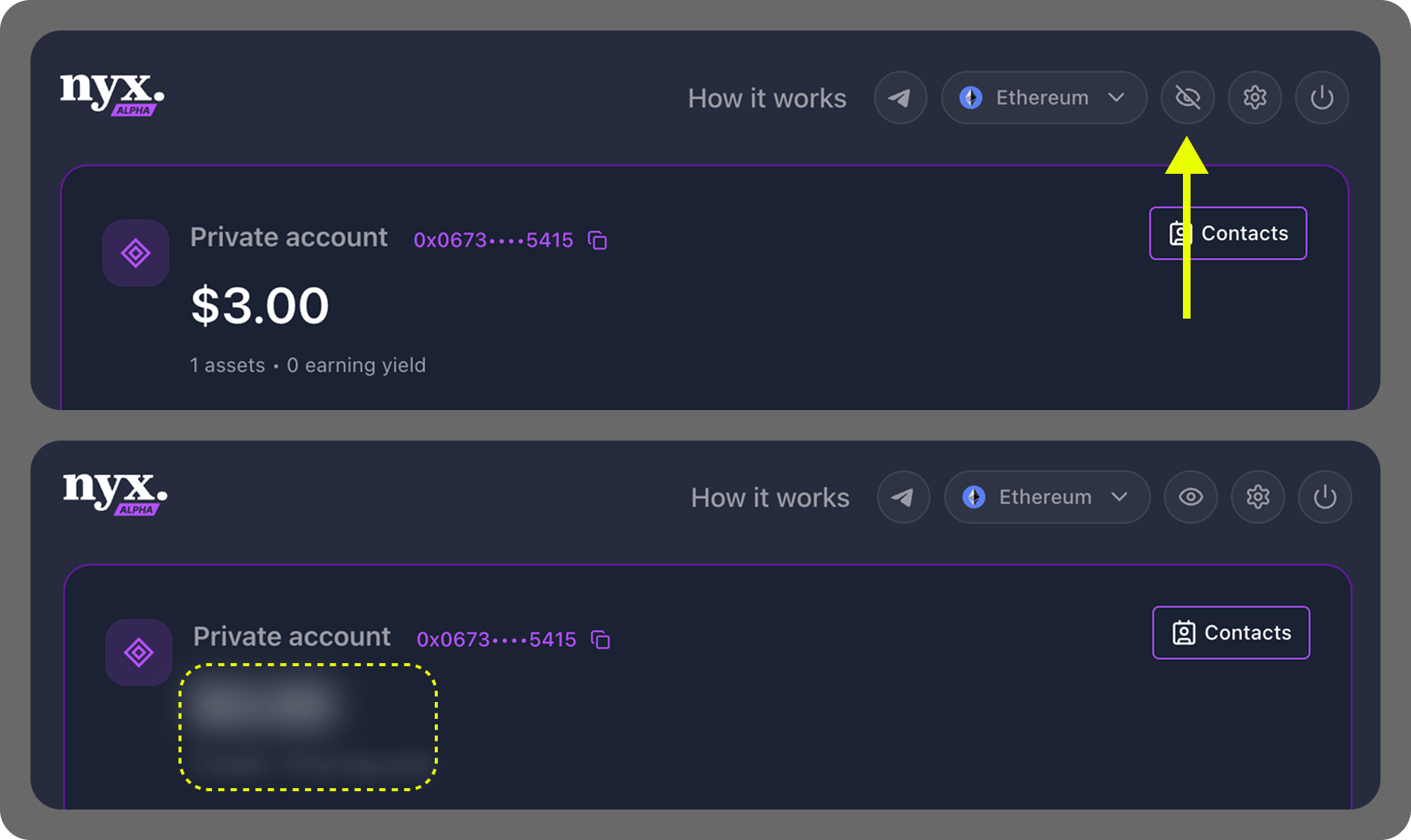
We only show your overall balance here, but all other balances on screen will also blur.